






Perform with FCC S.A.
Join our Content Team to create and share knowledge.
Learn how to be part of it


Be acquainted with our purpose, values, history and all that makes the FCC S.A. essence

A portfolio of products and solutions plenty of innovation, technology and sustainability.

To deliver products with leading edge technology and global quality is just our starting point. That is why we have a series of exclusive services for our customers and that make all the difference on a daily basis.

See in practical terms how innovation is present in the FCC S.A. DNA

Sustainability is present in every solution, delivery and process of our company: learn more.

We are made of synergy! Learn how you can become a FCC S.A. supplier

Learn how it is to work with FCC.S.A. Learn our culture, programs and check for opportunities.

Integrity and transparency are part of what we are. Check our annual reports and see the result of our work.

Find a variety of contents that permeate our businesses and see how you can be a part of what we create around here.

Together, we create more! Be a FCC S.A. partner and generate value for a world in transformation: learn how.

When the UFCC operations team least expects it, the yields start to change. The conversion drops a few points, gasoline production decreases, the RON of naphtha slightly reduces, and coke formation begins to increase. The temperatures appear to be normal, the thermal balance shows no obvious deviations, and the operational variables remain within the expected range. Even so, something in the unit no longer behaves the same way. At this moment, management starts asking questions: what has changed? What is happening at UFCC?
In daily operations, the control of variables such as the temperature of the riser, feedstock preheating, the steam flow rates, and the replenishment of the catalyst usually receives more attention. However, experience shows that variations in feedstock composition can significantly affect the unit’s performance, even when operational conditions remain stable.
FCC units can process a wide variety of streams from different refinery units. In practice, the composition of the UFCC feedstock depends not only on the type of current sent to the unit but also on the operational conditions of the upstream units, which can alter the quality of the feed.
Due to this variability, the quality of the feedstock becomes a determining factor for the behavior of the process, directly influencing conversion, product yields, coke formation, naphtha quality, and catalyst stability.
For this reason, the systematic execution and continuous monitoring of feedstock quality analyses constitute a fundamental tool for correctly interpreting the unit’s behavior, acting proactively in daily operations, and identifying opportunities for process optimization.
Understanding what is really entering the unit is the first step to interpreting the behavior of FCC. In the refining process, monitoring the quality of the feedstock is primarily based on a set of relatively simple and widely available laboratory analyses, which are part of the routine determinations in refineries.
It is important to emphasize that no isolated analysis can fully explain the behavior of feedstock in the FCC unit. Each parameter provides a piece of information, and it is the combination of these results that allows for a more complete understanding of the nature of the feed and its potential impact on the unit’s operation.
Among the most commonly used analyses for monitoring the operational quality of FCC feedstock are:
Each of these parameters provides clues about how the feedstock may behave within the riser and what its impact may be on conversion, product yields, and coke formation.
When these indicators are monitored systematically, the operation team can anticipate optimization opportunities and take action before the impacts become significant and the yields and quality of the products start to be affected.
In addition to the basic analyses used for the routine monitoring of the feedstock, there are other determinations that, although not always performed with the same frequency, can provide very valuable additional information about the nature of the feed entering the FCC unit.
Among these complementary analyses are, for example:
These analyses allow for a deeper understanding of the chemical structure of the hydrocarbons present in the feedstock and to more accurately estimate their degree of aromaticity, their paraffinic or naphthenic character, and consequently, their potential behavior during the catalytic cracking process.
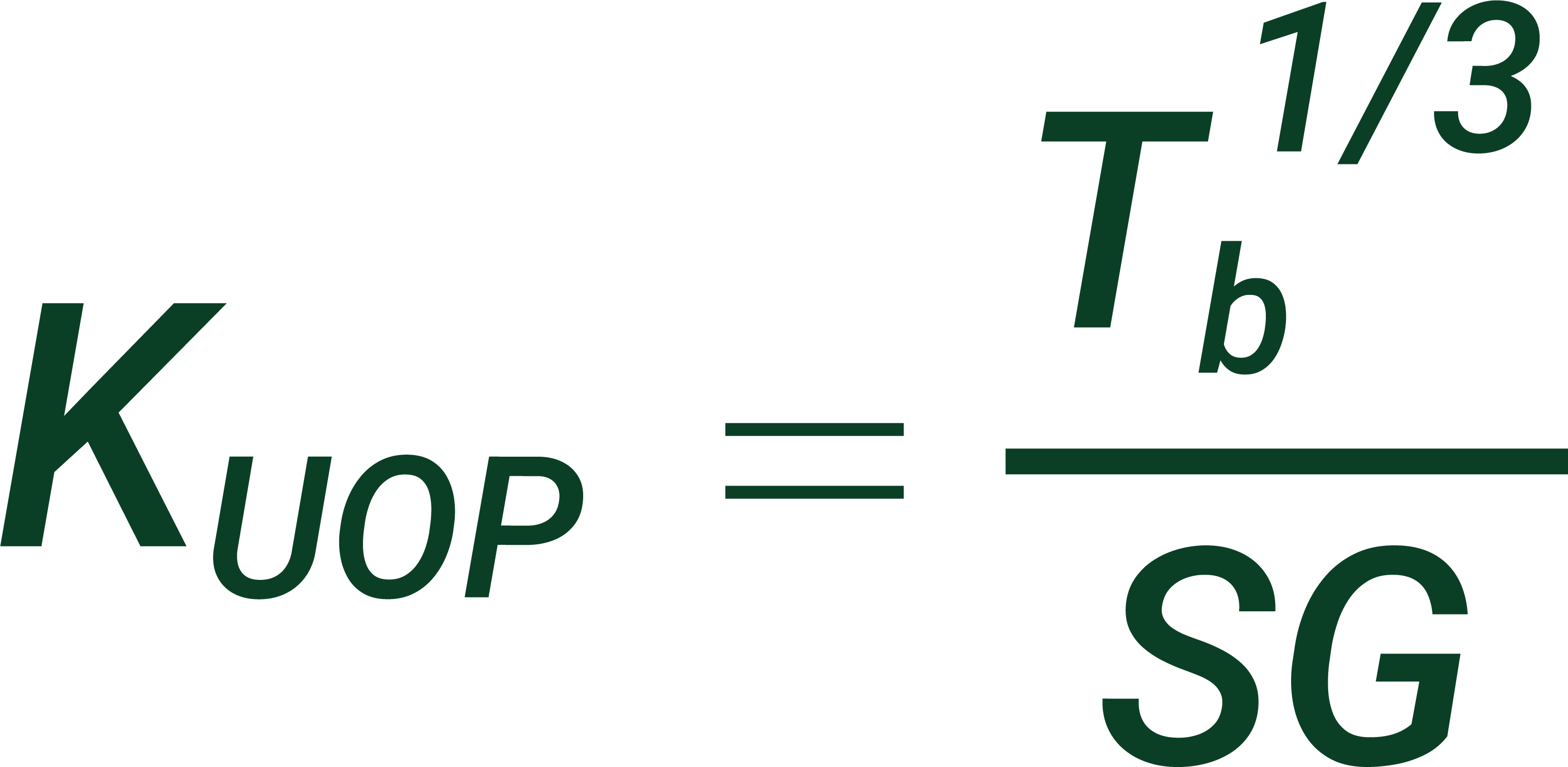
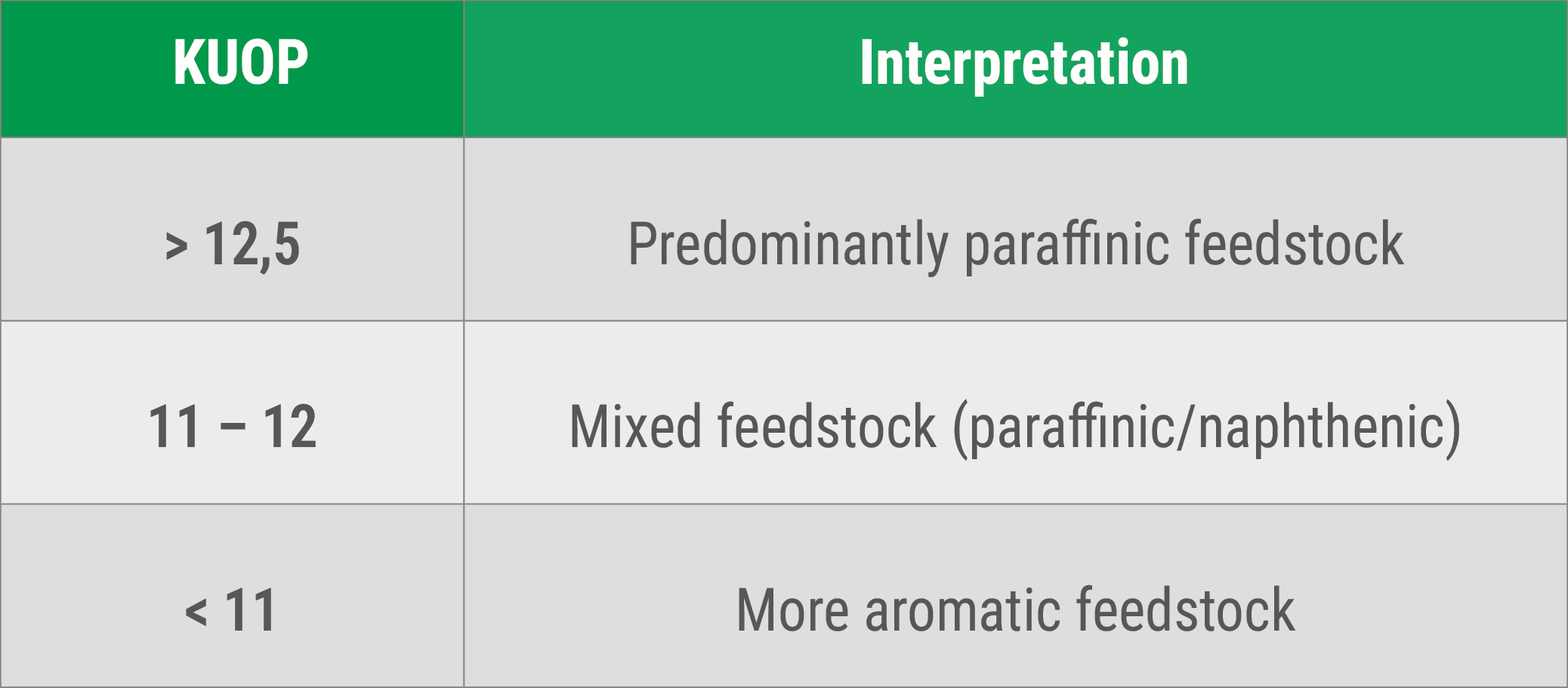
In addition to these direct determinations, it is also possible to obtain additional information through indicators calculated from basic analyses. One of the most well-known indicators is the Watson characterization factor or UOP K factor (KUOP), widely used in the refining industry to estimate the paraffinic or aromatic character of a stream.
This indicator is calculated using results from basic feedstock analyses, such as density and average boiling temperature.
The relationship between these properties is expressed by the following equation:
where:
Tb: average boiling temperature in degrees Rankine.
SG: specific gravity of the feedstock.
-
In general, streams with higher KUOP values tend to show greater conversion potential in the FCC and higher production of light products, while more aromatic streams usually exhibit lower reactivity and a greater tendency to form coke.
In addition to the KUOP factor, the technical literature also describes other indicators derived from the characterization of the feedstock that allow for a deeper interpretation of its behavior in the process. Among them, the following stand out: hydrogen-carbon (H/C) ratio; hydrogen content of the current; Aromatic Ring Index (ARI) and n-d-M structural method. In practice, these indicators allow translating laboratory results into useful information for the unit’s operation.
The characterization of the feedstock through the analyses and indicators presented in the previous sections allows for a better understanding of the nature of the feed that enters the FCC. However, the true value of this information emerges when the results are interpreted together and translated into operational actions capable of optimizing the performance and profitability of the unit.
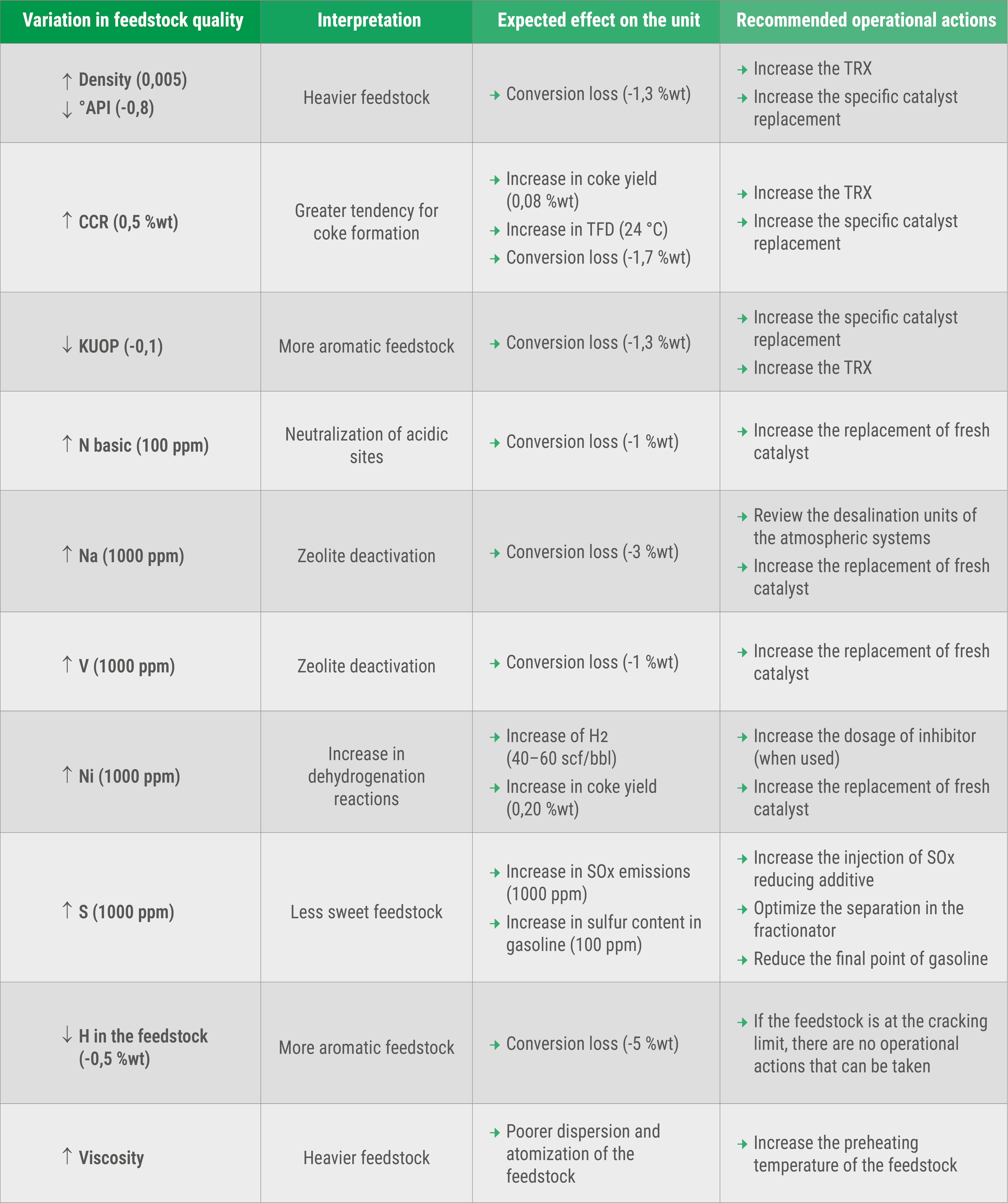
The following presents a general guide that relates some typical variations in feedstock quality with their expected effects on the unit and possible operational optimization actions that can be considered.
In this guide, it is assumed that the steam from the stripper is adjusted for maximum efficiency, as well as the steam from the injectors and the lift, properly optimized. Thus, the guide focuses on the main independent operational variables that allow for immediate action by the unit’s operation team.
-
As can be seen in the table presented, different variations in feedstock quality can generate specific impacts on the performance of the FCC unit. The proper interpretation of these changes allows for the identification of possible operational actions that can be implemented by the unit’s team to mitigate these effects. In this way, the table can be used as a quick reference guide that facilitates the interpretation of feedstock analyses and supports decision-making in the daily operation of the unit.
The quality of the feedstock is one of the most determining factors in the performance of a Fluidized Catalytic Cracking unit. As discussed throughout this technical moment, variations in feed quality can directly influence conversion rates, product yields, and consequently, the profitability of the unit.
The systematic monitoring of feedstock analyses, along with the use of indicators derived from these results, allows for a better understanding of the nature of the feed entering the FCC and anticipating possible changes in the behavior of the process. When this information is interpreted in an integrated manner, it becomes a valuable tool to support operational decision-making and identify optimization opportunities within the unit.
The technical team at FCC S.A. is available to assist its clients in interpreting feedstock quality analyses, evaluating possible operational actions, and identifying optimization opportunities. In the same way, through the use of thermodynamic simulation tools, such as FCC_SIM, and the integrated analysis of operational data, it is possible to deepen the understanding of the unit’s behavior and provide greater technical support for decision-making in daily operations, thus contributing to maintaining maximum performance and profitability of the FCC unit.
Related publications





What did you make of the publication?